
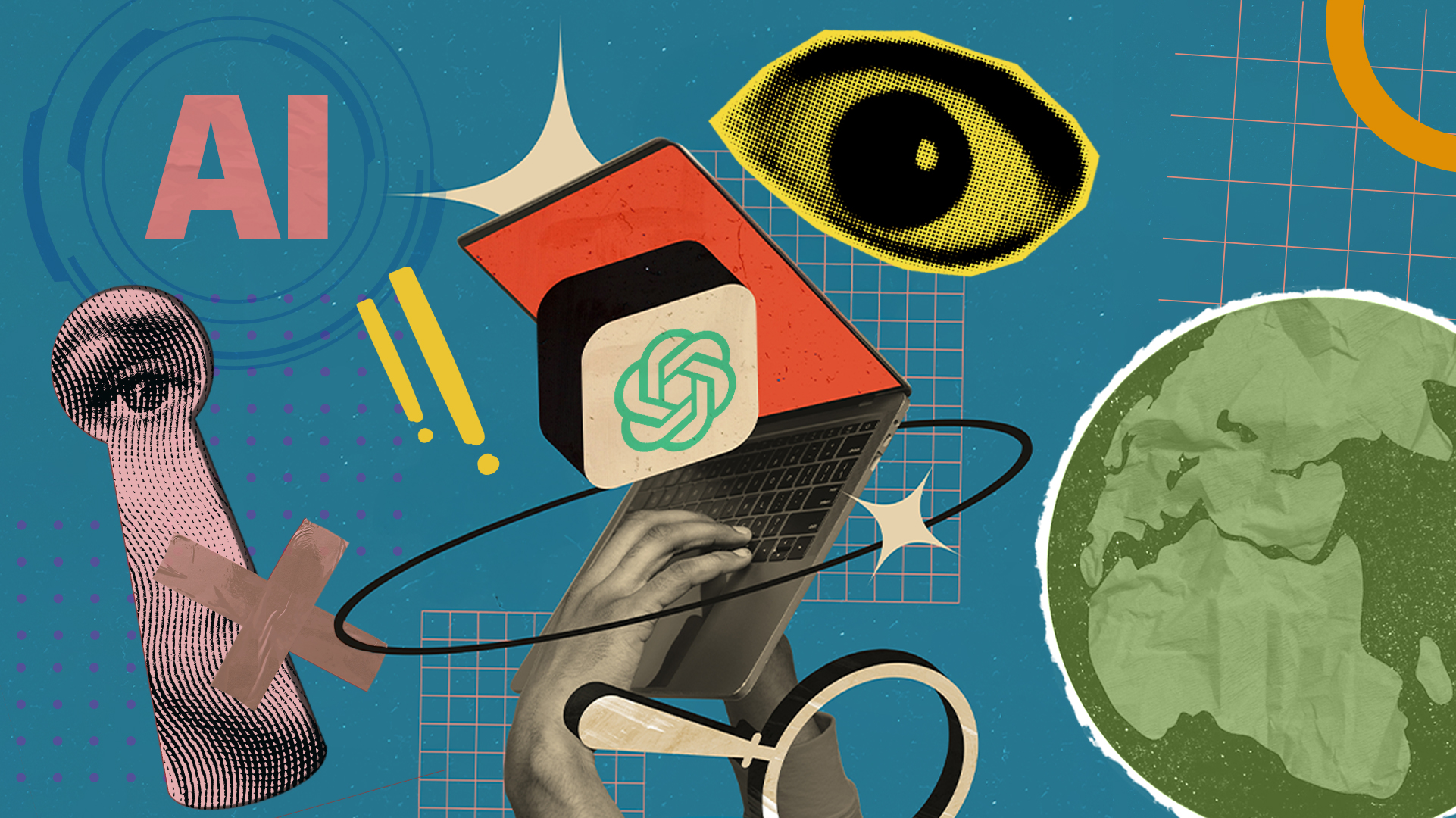
Let’s take a look around: artificial intelligence is now everywhere. From chatbots to images generated in a matter of seconds, right through to facial recognition systems, this technology is revolutionising the way we live and work. Yet, despite its incredible progress, there are aspects that are still not discussed enough, including its environmental impact, ethical implications and privacy risks. But the list could be much longer.
Please note: we don’t want to convey the message that AI is the enemy. Artificial intelligence is our friend, because it allows us to perform complex tasks in no time at all. Or, it is useful because it can help us develop our own ideas and broaden our horizons. But without first having answers to certain questions – are our chats with AI recorded? How much of an environmental impact does asking ChatGPT ‘what can I have for dinner tonight’ have? Am I sure that the information AI has provided me with is correct and verified? – perhaps using AI to satisfy every curiosity we have isn’t exactly a wise choice.
Artificial intelligence (AI) and the environment: a hidden cost
When we talk about artificial intelligence, we often talk about efficiency, progress and optimisation. But have we ever considered the price our planet has to pay? Running these systems requires a massive infrastructure that consumes energy and natural resources. The question is not so much whether AI is sustainable or not, but how much and how we can reduce its impact.
Energy consumption and CO2 emissions
Every time we ask an AI model to generate text or an image, a complex process requiring significant computational power takes place behind the scenes. For years, there has been talk that training a large language model could emit up to 300 tonnes of CO₂, equivalent to the emissions of five cars over their lifetime, following the publication of a study by the University of Massachusetts Amherst.
However, a new article published in TechCrunch (January 2025) suggests that AI may not be as energy-intensive as initially thought. According to the research, many previous estimates did not take into account recent improvements in data centre efficiency and the growing use of renewable energy to power AI infrastructure.
Where does the truth lie? At present, we do not know. Probably somewhere in between, because the methods used by companies to extract this data are not clearly explained. What we do know, however, is that the greatest impact is generated behind the scenes, and in particular, in data centres.

Water consumption: the overlooked aspect
Turning our attention to data centres takes us beyond the issue of electricity consumption. The data centres that power AI models require massive cooling systems to prevent the machines from overheating. Most use water for this purpose, and the result is startling – in a negative sense: a simple 100-word email generated by ChatGPT-4 can consume more than half a litre of water.
If we multiply this figure by the millions of daily interactions made by users across the globe, water consumption becomes a very, very serious issue.
Renewable energy and potential mitigation measures
The good news is that – at least in theory – there are a number of solutions. Renewable energy, optimising computing processes… the list goes on.
The real problem – as we mentioned earlier – is that many companies do not publish their energy consumption data, leaving a lack of transparency that prevents an objective assessment of AI’s impact. But the environmental impact is not the only downside of AI.
Privacy: is it under threat?
Artificial intelligence has opened the door to a new way of collecting and analysing data. This processing capability is fascinating, but it also carries significant risks. Privacy protection – there’s no point beating about the bush – is one of the most critical issues surrounding AI.
Data protection
Who oversees the data we provide to artificial intelligence models? UNESCO’s Recommendation on AI Ethics highlights the need for clear regulations to prevent misuse. Many AI tools collect and use personal data without the user being fully aware of it. And this raises questions about their future use.
GDPR and regulation
The European Union is seeking to curb the risks associated with AI through the AI Act, a set of rules designed to ensure the ethical use of artificial intelligence. However, there are concerns that it may overlap with the GDPR, the General Data Protection Regulation, which could lead to confusion and regulatory gaps. Here too, the lines are blurred.

Ethics and AI: who is responsible?
If an artificial intelligence makes a wrong decision, who is held accountable? The lack of direct accountability is one of the major ethical challenges posed by AI.
Bias and discrimination
AI models are not neutral. As they are trained on vast amounts of data, they can inherit biases present in the source data. This can lead to unintended discrimination, ranging from a simple response that offers a one-sided view to a recruitment system that disadvantages certain social groups.
Ethics by Design
One possible solution is ‘ethics by design’, which involves incorporating ethical considerations right from the earliest stages of AI development. This means making decision-making criteria transparent, testing models to identify biases, and establishing clear rules of accountability. We discussed this in an article on our MAG some time ago, starting with a question: why is booking a flight such a long and difficult process?

The future of AI depends on us
Artificial intelligence, as we were saying, does not automatically cause problems. The problem lies in how we use it without adequate training and awareness. On the one hand, we have an extraordinary opportunity to improve efficiency and innovation; on the other, we risk creating a system that consumes too many resources, infringes on privacy and exacerbates inequalities.
The right path most likely lies somewhere in between: regulating, innovating and making AI a tool for sustainable and inclusive progress. In its own small way, Propaganda3 will try to do its bit. From creating exhibition stands with an Ecodesign approach to websites built from scratch to reduce unnecessary consumption (like this one), we hope to find partners who, like us, appreciate innovation but are also concerned about its consequences.
Fancy a chat? Fill in the form below and we’ll find the most eco-friendly way to meet up 😉