
If you manage an Instagram or TikTok page for a brand or business—or if you simply enjoy sharing content with your followers—you’ve likely noticed a shift: following the latest social media algorithm updates, video content is being prioritized far more than photographs, graphics, or any other static content.
The numbers speak for themselves: compared to images and carousels, videos perform better across the board, driving higher interaction rates and reaching a vast number of users. There is a specific reason for this. Platforms like TikTok and Instagram Reels have redefined how we consume media by shifting their algorithms, forcing brands and creators to re-evaluate their content strategies to prioritize moving images.
This article explores the dominance of video within the social media ecosystem, with a specific focus on the algorithms governing TikTok and Instagram Reels. It also offers insights on how to maximize visibility and engagement through strategically optimized video content.
Understanding social media algorithm
The algorithms used by Instagram and TikTok are designed to prioritize content that generates the highest engagement, making video one of the most powerful tools for reaching and connecting with an audience. Understanding how these algorithms work can help businesses and marketing professionals leverage these platforms effectively to reach their target audience.
But why have algorithms chosen to favor video content specifically? In reality, the reason is more psychological than technological. According to a study by Synthesia, users retain 95% of a message when it is delivered through video, compared to only 10% when the message is text-based. This happens because the human brain processes video content up to 60,000 times faster than text.
Both Instagram (Meta) and TikTok are well aware of these statistics, which is why they both continuously evolve and update their algorithms. However, there are substantial differences between the two platforms regarding how they recommend content to users, particularly within their respective “For You” sections. Let’s look at some of them.

Instagram Reels vs TikTok: key algorithmic differences
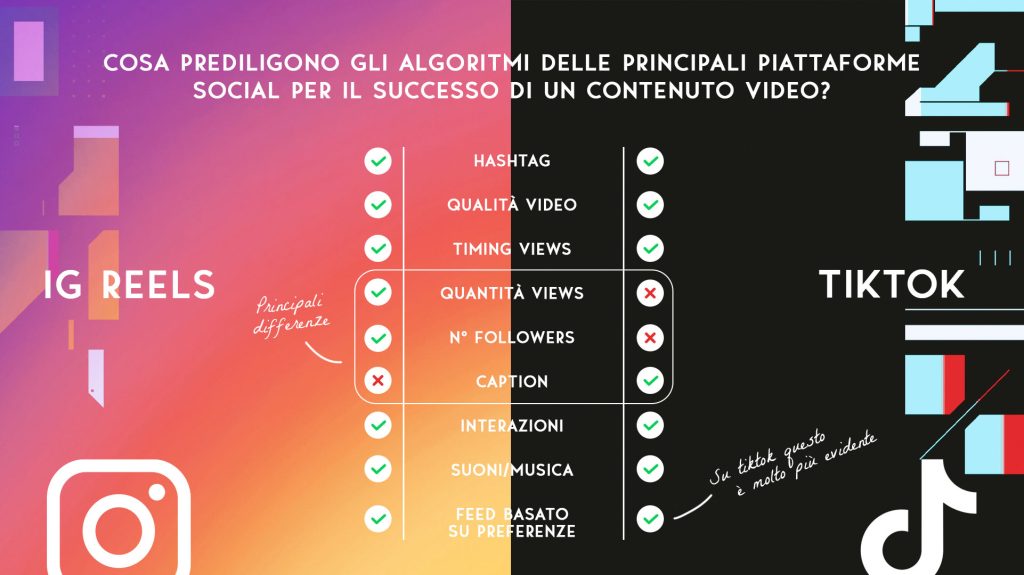
Although Instagram Reels and TikTok are both pillars of the video content landscape, their algorithms weigh different parameters when “choosing” which content to display on For You pages.
One of the most significant differences concerns account authority. While the Instagram Reels algorithm tends to favor content posted by accounts that already have a large and established following, TikTok is much more “democratic”: even an account with only 10 followers can go viral if they post the right video.
Another discrepancy lies not in the video itself, but in the metadata provided in the post descriptions. On Instagram Reels, captions help users better understand or dive deeper into the content, but they don’t heavily influence the algorithm’s reach. Conversely, TikTok places immense value on this information, using it to categorize content and even make it accessible to the visually impaired.
Because of this, TikTok rewards accounts that provide detailed information beneath their videos, specifically through the use of keywords and descriptive text.
Despite these differences, TikTok and Reels also share many common parameters, which are crucial to consider before cross-posting the same video on both platforms.
Instagram Reels + TikTok: what they have in common
Creating a video that performs well on both Instagram Reels and TikTok isn’t easy, but it is certainly possible, especially if, during the recording process, we prioritize the features favored by both algorithms. These elements can help us achieve strong results across key metrics, such as:
- Average watch time
- Engagement rates (Interactions)
- The use of relevant hashtags
Focusing on these data points gives our content a competitive edge, regardless of the platform where it is published.
Another shared element is the “For You Page” (also known simply as the Feed), which in both cases is personalized based on user preferences. But how do these algorithms actually understand what we like or dislike? It’s quite simple: they calculate our interest through precise, measurable metrics like average watch time and more “general” signals like likes, comments, and shares.
However, there is a substantial difference here as well: on TikTok, the degree of feed personalization is much more evident. For us users, this is entertaining on one hand, as we are constantly presented with content we are highly likely to enjoy.
On the other hand, this extreme personalization carries a risk: the creation of “filter bubbles” within our feed. This happens when we are shown hundreds of very similar pieces of content day after day. The danger here is boredom and a lack of space for discovering new, potentially interesting topics.
Creating effective video content
Creating videos that capture attention and drive interaction is no small feat. This section of the article outlines best practices and tips for creating effective video content that not only entertains and informs but is also optimized to perform well within the Instagram and TikTok algorithms.
Remember, the goal of social media algorithms is to show users content that genuinely interests them. Therefore, the more your content reflects your audience’s interests, the more likely it is to be noticed, appreciated, and consequently rewarded by the algorithm.
The following tips are presented in chronological order, guiding you step-by-step through the phases of ideation, creation, and monitoring of your content.
Know your (potential) audience
The first thing, before you even hit the record button or decide on a topic, it is crucial to understand who is on the other side of the screen. What is my audience looking for? What are their interests, pain points, or desires?
Creating video content that resonates directly with the needs and expectations of your followers (and potential new viewers) significantly boosts your chances of engagement and shares, maximizing the video’s potential.
Create authentic content
There is no value that engages people better than authenticity. Users are experts at recognizing when content is natural and genuine versus when it has been engineered just to “chase likes,” which often feels forced.
Videos that reflect transparency tend to build a stronger connection with the audience. It gives them a chance to identify with the story being told and see themselves in it, experiencing the same emotions as the creator.
Optimize for the initial hook
The first few seconds of your video are decisive. With an overwhelming amount of content available, attention spans are incredibly short; users take only a fraction of a second to decide whether to skip a video. Make sure your content starts with a powerful hook that entices them to keep watching.
You can create a hook through a provocative question, a surprising statistic, or a curiosity-piquing clip. The key is to capture interest and hold it for as long as possible.
Prioritize quality
Video quality is fundamental. A high-quality video—both in terms of content and production—has a much better chance of being watched, shared, and remembered. And we aren’t just talking about visuals: audio matters just as much.
Using suitable music and crisp, clear sound effects will be a “joy for the ears,” making viewers much more likely to stick around for the visual experience.
Add captions
Adding captions (subtitles) to your social media videos is essential for several reasons. First, many people watch videos in public spaces, like offices or public transport, where audio might not be appropriate. Second, social platforms often play videos on mute by default, making captions vital to grab attention. Third, captions are crucial for making content accessible to the hearing-impaired.
Overall, including captions improves message retention and can positively impact your view metrics.
Research hashtags and descriptions in advance
Hashtags and descriptions aren’t just for labeling; they are powerful tools for visibility. Use relevant, targeted hashtags to reach your specific audience and include pertinent keywords in the description to improve your chances of being discovered by new users through search.
Incorporate a Call-to-Action (CTA)
What do you want your audience to do after watching? Whether it’s liking, sharing, commenting, or following your profile, a clear Call-to-Action guides the user toward the desired goal. Place your CTA strategically within the video or the description to maximize its effectiveness.
Monitor and adapt
Finally, analyzing performance is essential. Use the native analytics tools provided by Instagram and TikTok—or external platforms—to track metrics like views, engagement, and completion rate. This data will reveal a lot about your content and help you understand what could be improved for your next video.
Pray to the Goddess of Luck
The funniest part? All these tactics work and are highly recommended, but they still might not be enough to go viral. Often, the reasons behind a video’s massive success are obscure and unpredictable. Content that seems trivial can achieve insane results for no apparent reason.
Stay updated to anticipate trends
We have explored how to optimize videos for social media success, but we also know that it is not an exact science. One undeniable truth remains: both Instagram and TikTok have demonstrated the immense power of video content in capturing user attention and driving engagement. By understanding and leveraging their algorithms (as much as possible), brands and creators can maximize their online presence and impact.
As platforms continue to evolve, staying up to date with best practices and optimization strategies will be crucial for success in the dynamic world of digital marketing. With the constant evolution of social media and user preferences, attempting to seize current trends and anticipate future ones is essential to remain relevant.
Our Multimedia Unit stays constantly updated on the latest developments in video production and social algorithms. To see some of the content we’ve recently created, take a look at our Reels on Instagram and Facebook.